5 November 2026
Habit, trust and accountability: what Zomato and Urban Company teach us about building a freelance marketplace in India
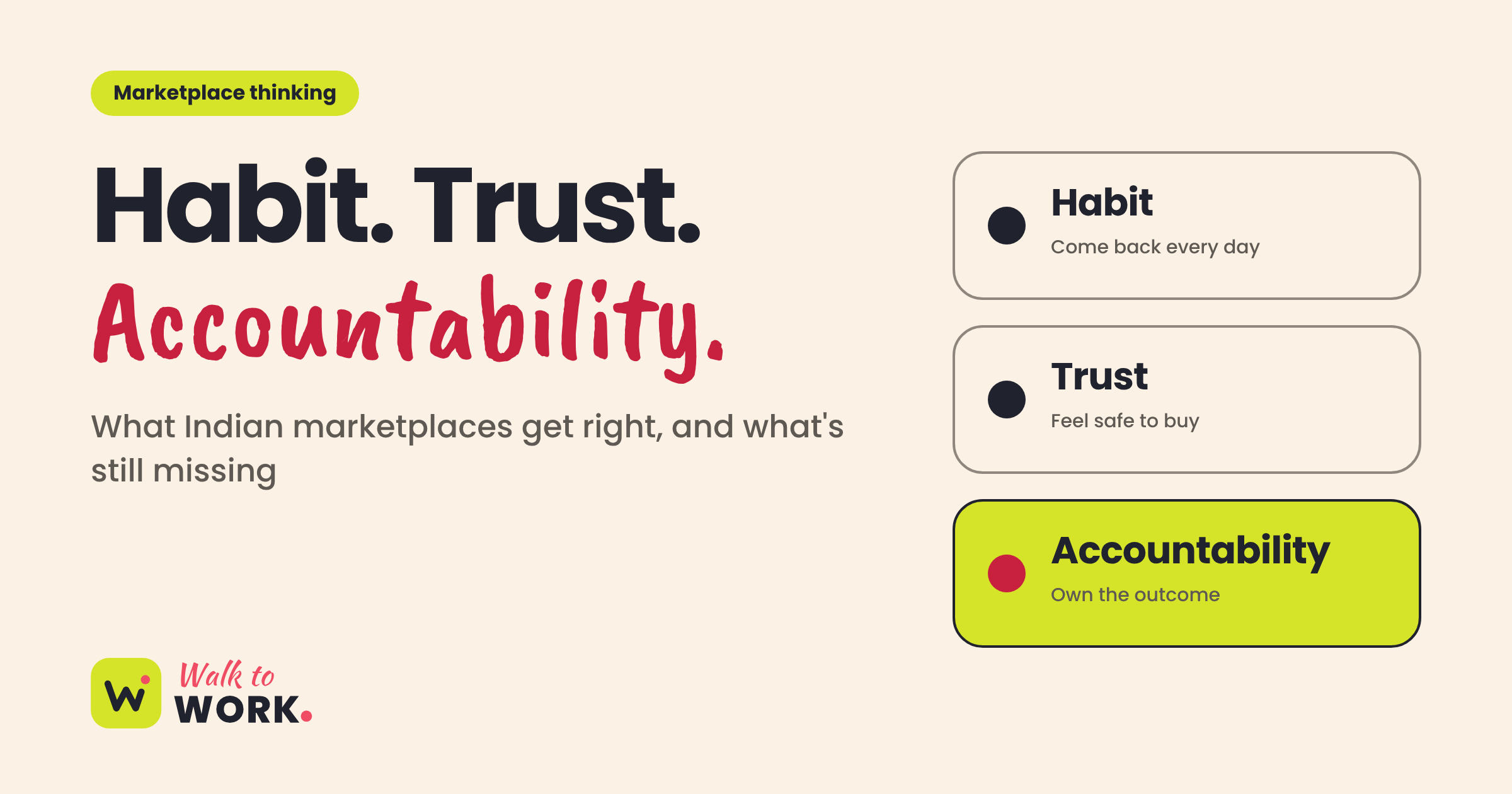
Every big Indian marketplace runs on one thing that keeps people coming back. For Zomato it is habit. For Urban Company it is trust. For a freelance marketplace in India, where the work is custom, the money is on the line and no two projects are the same, it has to be accountability.
While studying Indian marketplaces, we kept noticing this pattern. It explains why hiring a freelancer still feels risky for many businesses, why about 61% of surveyed Indian freelancers have gone unpaid at least once, and what a better freelance marketplace should do about both.
This guide walks through the pattern, shows what accountability looks like in practice, and answers the questions people most often ask before they hire freelancers in India or join a marketplace as one.
Zomato is built on habit
Zomato sells something people want every day: food. In the January to March 2026 quarter, its food delivery business averaged 25.4 million monthly transacting customers, up from 20.9 million a year earlier, according to the reported Q4 FY26 results.
That is a habit business. Dinner comes around every night, so the app only has to be easy and reliable enough to be the first thing you open. The stakes of each order are also low. If a biryani is late, you lose one meal, not a month of work.
Habit is powerful, but it needs frequency. Almost nobody hires a logo designer every week.
Urban Company is built on trust
Urban Company sells something people need only occasionally: a cleaner, an AC repair, a salon visit at home. These jobs are less frequent and the stakes are higher, because a stranger is coming into your home. So the platform has to earn trust before anything else.
Its own FY23 business summary shows how it does that:
• Customers rated its services 4.82 out of 5 on average.
• It had invested more than ₹250 crore in training service professionals since it began.
• Every new professional gets training, and trainers and senior partners support them for their first 30 to 60 days.
• Customers acquired before FY23 still made up about 77% of net transaction value that year, which suggests that once people trust the platform, they come back.
The lesson is that trust is not a slogan. It is built by setting a standard for the work and then checking it, job after job.
Freelance work needs a third thing: accountability
Freelance work does not fit either model. It is not frequent enough to run on habit. And trust alone is not enough, because even honest people can disagree about what was agreed. A project is custom, the result is hard to describe in advance, and someone has to go first, either the business paying before it sees the work or the freelancer working before they see the money.
The risk lands on both sides:
• Freelancers may finish the work and wait weeks for payment, or never receive it.
• Businesses may pay upfront and get late, unfinished or off-brief work, with nobody to turn to.
Businesses do not want to chase freelancers or manage every step. They want the work delivered. Freelancers do not want to chase clients. They want to be paid for work they have finished. Accountability for the outcome serves both.
What accountability looks like in a freelance marketplace
Accountability means that someone is answerable for the outcome, from the brief to the final file. On Walk to Work, we build it on four things:
- Clear scope: You know exactly what you are getting
- Fixed timeline: You know when the work will arrive
- Payment held until delivery: You pay only for work that is delivered
- Clear communication: One place to track progress
Put simply: habit brings people back, trust makes them try, and accountability gets the work done.
These are not new ideas. Good freelancers already ask for a written scope and an advance. A marketplace should make this the default, so nobody has to be the person who asks.
Why this matters now for freelancers and businesses in India
The freelance economy in India is growing quickly, and so is the need for a safer way to work together.
• More freelancers are coming. NITI Aayog expects India's gig and platform workforce to grow from 7.7 million to 23.5 million by 2029-30.
• Late payment is common. A PayPal survey of 500 Indian freelancers in 2018 found that about 61% had gone unpaid at least once.
• Small businesses feel it too. A 2025 report found they were still owed about ₹7.34 lakh crore in delayed payments as of March 2024.
• The buyer base is huge. More than 6.5 crore small businesses are registered as MSMEs, and they produce about 30% of India's GDP.
Many small businesses do not have an in-house designer, marketer or developer, so they turn to freelancers. A marketplace that makes hiring clear and safe helps both sides of that market.
If you are a freelancer, create your free profile on Walk to Work. If you are a business or brand looking for talent, see what you can book at walktowork.in.